
EXPERIENCE:
INDUSTRIAL DESIGN; AI IMAGE & VIDEO GENERATION
product design - '19
Originally developed as my 2019 thesis project, Festival Raincoat Collection explores how discarded advertising banners and industrial waste materials can be transformed into functional, wearable products.
The project focuses on short-term, intensive festival use, where durability, weather protection and visual character are equally important.

Through material and form experimentation, the initial concepts gradually evolved into simpler, more material-led constructions. Details such as collars, detachable hoods and complex pocket solutions were reduced in favour of durability, ease of assembly and freedom of movement.
This process gave the collection its final formal language: bold surfaces, simplified silhouettes and visible traces of the original banner material.


"Boogie"
The simplest of the three models, Boogie is made entirely from advertising banner material. Its classic hooded shape and short sleeves make it the most material-efficient piece in the collection.


"Folk"
Folk introduces a cape-like upper section and breathable back panel under it, creating a more ergonomic fit while keeping the bold protective character of the original material.


"Punk"
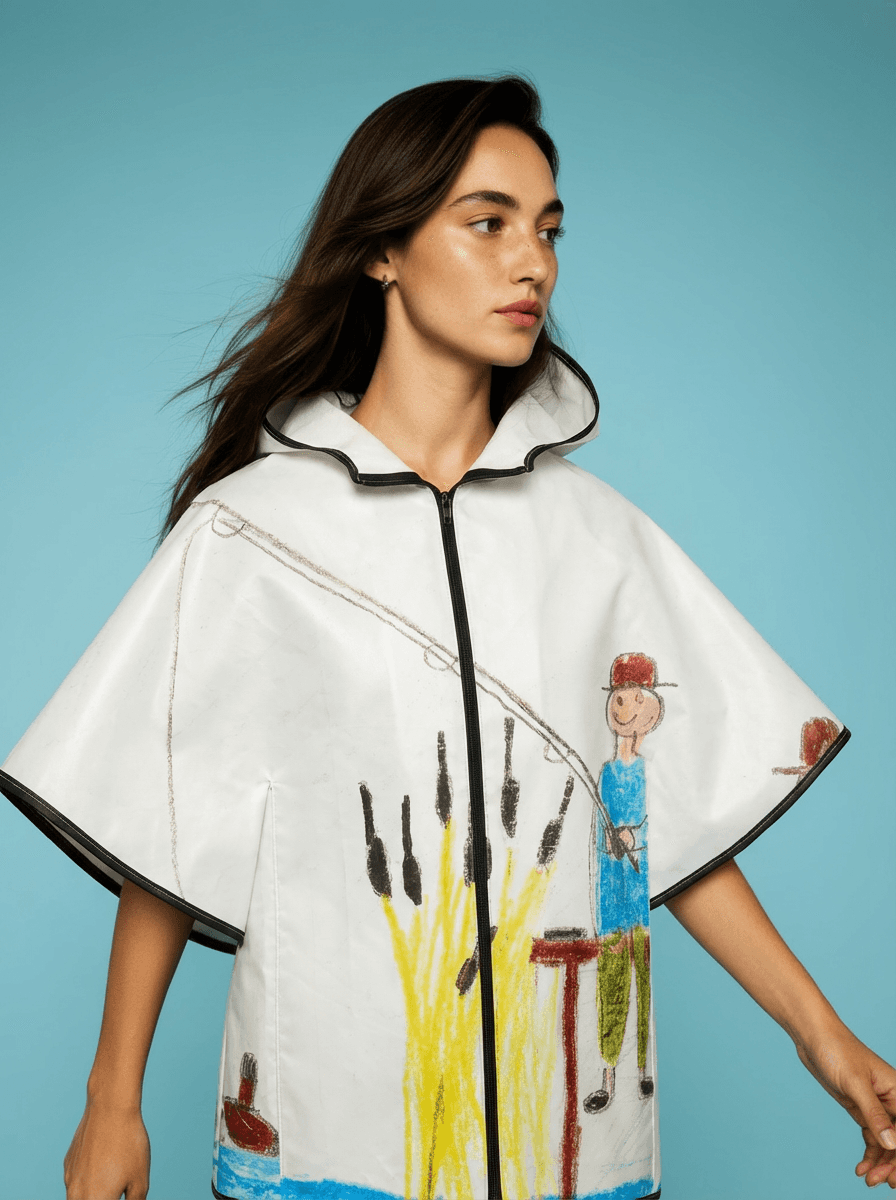
Punk is the most complex and comfortable model. A centre-front zipper, cape-like upper layer and breathable chest and back panels make it more flexible to wear, while preserving the sculptural quality of the banner material.
AI visualization - '25
In 2025, I revisited the project using AI image and video tools to visualize the garments in a more complete, body-aware context. The goal was not to replace the original product work, but to extend its presentation and show how the pieces could behave on a model and within their intended festival environment.


I used Higgsfield’s Fashion Factory feature to test how AI would interpret the unconventional shape, material rigidity and surface pattern of the raincoats. Early generations struggled with the construction, so I refined the workflow by simplifying the background and testing different reference images, from hanger shots to model photography.
The final stills captured the shine, stiffness and graphic quality of the banner material surprisingly well. I then used Photoshop and Gemini 2.5 to refine the styling, including rubber boots and hood placement, before using Nano Banana to visualize the product in a festival-like environment.


results
The final AI-assisted stills and animations gave the original product design a new layer of context, making the scale, material behaviour and festival use case easier to understand. The project now connects physical product experimentation with contemporary AI-assisted visualization, showing how older design work can be reinterpreted and presented through new tools.
Products created at Óbuda University
Consultant: Sándor Farkas, Medence Csoport